The Little App and The Big Store
Let me tell you a little story.
Grab a cup of coffee or whatever you drink when you are about to watch something simple become way too complicated.
There used to be a simple idea.
Someone built an app. The app did something useful. A person found it, installed it, used it, and decided whether it helped.
That was supposed to be the whole thing.
Build something useful. Make it available. Let people use it.
But then the app had to go live in the store.
And the store was not just a store anymore.
It was the shelf. The gate. The checkout counter. The review desk. The rulebook. The map. The traffic light. The sign above the door.
And once the little app walked into the big store, everyone suddenly had an opinion about how the app should survive there.
The App Store Machine
First came the listing.
The app needed a name. Then a subtitle. Then screenshots. Then preview videos. Then keywords. Then categories. Then reviews. Then ratings. Then privacy answers. Then in-app purchase rules. Then subscriptions. Then tracking disclosures. Then analytics. Then campaigns. Then reporting.
The little app thought it was finished.
But the machine was just waking up.
Because being in The Store does not mean people will find you.
So then come the helpers: ASO agencies, keyword trackers, screenshot designers, preview-video teams, paid app-install campaigns, attribution platforms, review tools, growth consultants, retention experts, subscription optimizers, analytics dashboards, and monetization advisors.
Everyone arrives with the same message:
We can help your app succeed in The Store.
And that sounds helpful.
Until you stop and ask the obvious question.
If The Store is already taking a piece of the sale, why does the app still need a whole second industry just to be seen inside The Store?
The standard app store commission for paid apps and in-app purchases is 30%, with reduced rates such as 15% for qualifying developers and subscriptions. The Store also sells app store ad placements, including search results and product pages. Apple's search ads materials describe auctions where relevance and bids matter.
So the little app pays to be in The Store. Then it may pay to be noticed in The Store. Then it may pay someone else to explain why it is still not being noticed enough.
That is when The Store stops feeling like a store.
It starts feeling like a casino with screenshots.
The Funny Part
The funny part is the app is treated like a money machine before anyone has even used it.
The moment you say, "I own an app," the world reacts like you found oil in your backyard.
People start circling. Not because the app helped someone. Not because the product worked. Not because users came back.
But because the app now lives inside a system where everyone knows there are fees, rankings, installs, ads, data, subscriptions, retention curves, and reports to sell.
The app becomes less like a tool and more like a little storefront inside someone else's mall.
And the mall has a lot of rules.
Want better placement? There is a system for that.
Want better discovery? There is an agency for that.
Want better keywords? There is a dashboard for that.
Want better conversion? There is a consultant for that.
Every answer costs money. Every helper needs access. Every layer promises growth.
And slowly, the simple app disappears behind the business of making apps look successful.
The Privacy Label Problem
Then comes the privacy label.
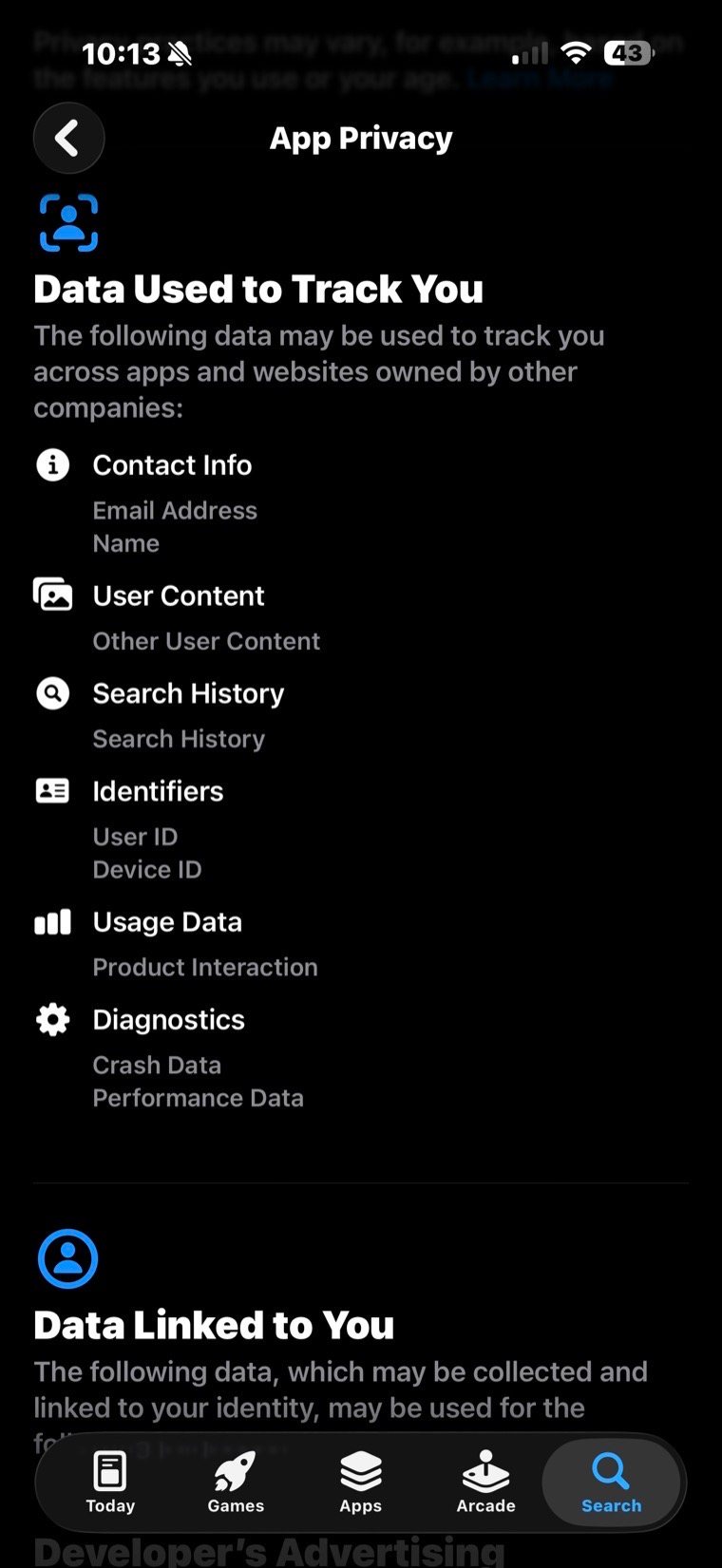
The Store asks: does the app collect data, track users, link data to people, or use third-party partners?
Those are fair questions. Users should know what a product collects.
Apple requires developers to explain app privacy practices, including data collected by the app and third-party partners, and those disclosures can show whether data is linked to the user or used for tracking.
But there is also something strange about the whole scene.
The Store asks the little app to explain what it tracks.
Meanwhile, The Store itself is sitting in the middle of the search, the tap, the ad, the install, the payment, the ranking, the review, and the report.
The Store is not outside the system.
The Store is the system.
So yes, the app has to answer for what it does. But the larger story is this:
The app is being judged by a machine that is also measuring the app, monetizing the app, ranking the app, and selling visibility around the app.
That is the part most people never see.
Old Way
Enter the Store
Build the app. Submit the app. Wait for reviews. Follow the rules. Answer the privacy questions. Set up the payments. Optimize the listing. Buy the ads. Track the installs. Study the dashboard. Hire the agency. Adjust the keywords. Refresh the screenshots. Chase the ranking. Repeat.
That may be normal now.
But normal does not always mean clean.
Because somewhere along the way, the app stopped being just a product. It became an object inside an economy.
The founder owns the app.
But The Store owns the path to the app.
And whoever owns the path gets to charge rent along the way.
New Way
Walk Through the Front Door
Here's why we like the Progressive Web App path.
A Progressive Web App does not begin inside a crowded store shelf.
It begins where the user already is: on the web.
The person finds the product page. They read what it does. They decide whether it fits. They install it from there. They come back to it from the home screen.
No app-store maze. No buried listing. No second trip through someone else's marketplace. No pretending the website is just a waiting room before the real product begins.
The web can be the front door.
That is the practical part: a modern web tool can live on the device, carry its own icon, and open in a focused window when the browser supports it.
That matters.
Because when someone is already on your site, they are already in the right place.
App stores are designed to feel frictionless on the surface while hiding the entire platform economy underneath.
Why do that?
What We Do Differently
Circle the People is not building software that gets swallowed by The Store machine.
We build useful tools that are easy to understand, easy to reach, and easy to return to.
That is why PWA installation makes sense.
The tool should not need a parade of middlemen before a person can use it. The user should not have to search through a marketplace when they are already standing on the product page.
The product should be clear. The path should be direct. The relationship should be cleaner.
Not perfect. Not magical. Not pretending the web has no rules.
Just lighter.
A useful tool should not have to become a whole machine before it helps one person.
The Real Point
The app store had its moment. It helped people discover software. It made installing apps feel familiar. It gave users a place they understood.
But over time, The Store has become more than a store.
It became a surface people fight to appear on.
And once every surface becomes something to optimize, bid on, track, and monetize, the product starts serving the system instead of the user.
We are choosing a different path.
Not because we hate app stores. Because we like directness. Because we like cleaner incentives. Because we like the old idea that if a product works, people should be able to find it, install it, use it, and come back without a giant machine standing between them and the tool.
No store maze. No ranking theater. No paid shelf drama. No little app trapped in the big mall.
Just the web. Just the product. Just the person who came looking for help.
And if it works, they use it again.
The Question Underneath
The Store asks every app: do you track the user?
Fair question.
But maybe users should also ask: who tracks The Store? Who profits when the app needs to be discovered? Who sells the visibility? Who owns the path? Who gets paid before the product ever helps anyone?
That is the difference.
The old way puts the app inside the machine.
The new way brings the user straight to the tool.
And for us, that is the cleaner path.
Further Reading
A few readable pieces behind the store fees, paid shelf space, privacy labels, and web-install path this story is pointing at.